Understanding wireless technology and standards like these is key to making sure you’re investing in technology and equipment that can support your organization’s short-term and long-term network-connection requirements. Wireless standards layout specific specifications that must be followed when hardware or software are designed related to those standards.
Now that we’ve covered the major wireless standards of the past, let’s look ahead at current standards – and what’s yet to come.
General-Purpose Applications
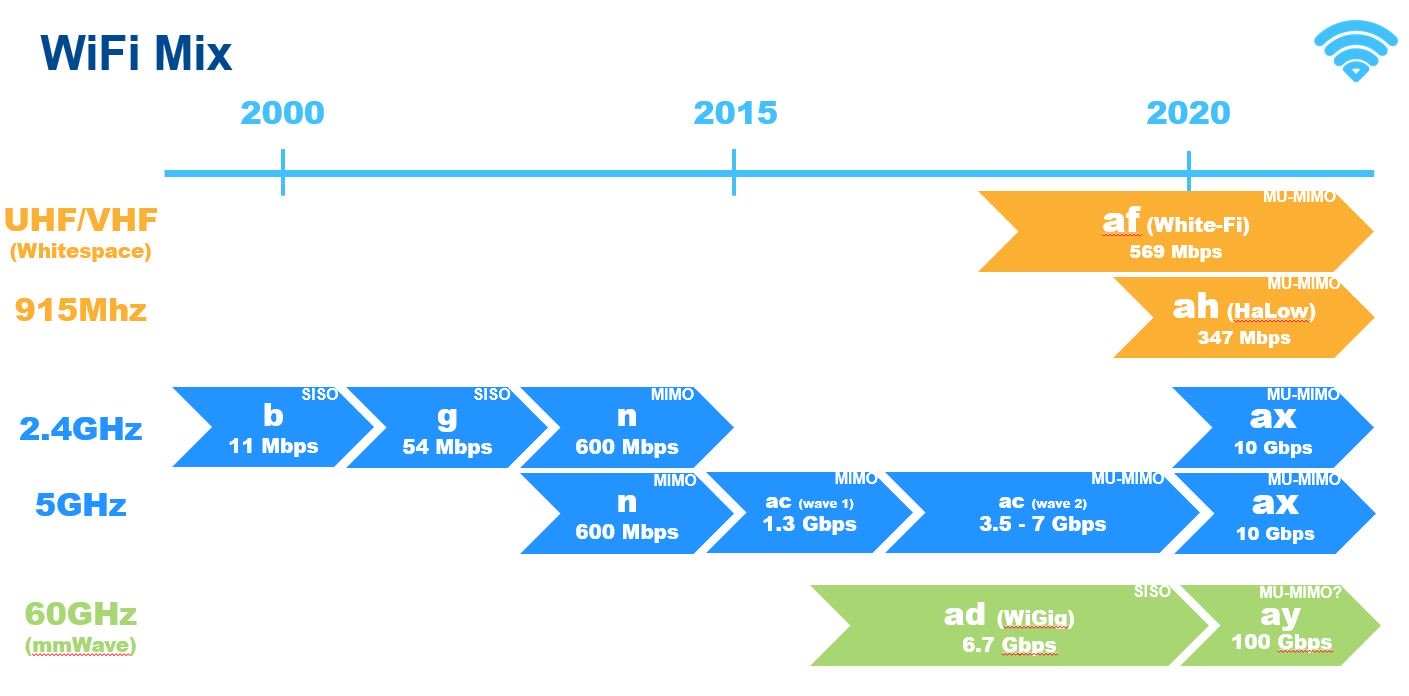
Today’s wireless standards, like IEEE 802.11ac (Wave 1 and Wave 2), operate in the 5 GHz frequency range. This standard is used for many general-purpose, short-range, multi-user applications, like connecting end devices to networks.
As we’ve mentioned in previous blogs, IEEE 802.11ax is the “next big thing” in terms of wireless standards. As the successor to 802.11ac, 802.11ax operates in both the 2.4 GHz and 5 GHz frequency spectrums. It will offer 10G speeds, and the ability for multiple people to use one network simultaneously with fewer connectivity problems (and while still maintaining fast connection speeds). It will improve average throughput per user by a factor of at least four as compared to 802.11ac Wave 1.
High-Performance Applications
Operating at an unlicensed frequency of 60 GHz are IEEE 802.11ad and IEEE 802.11ay, which are used primarily for short-range, point-to-point applications vs. point-to-multipoint applications. 802.11ay is an update to 802.11ad, improving throughput and range. As compared to 802.11ad, 802.11ay can offer speeds between 20Gbps and 40Gbps, as well as an improved range.
IoT Applications
Operating at lower frequencies are standards like 802.11af (UHF/VHF) and 802.11ah (915 MHz). These standards are designed for extended-range applications, like connecting hundreds of remote Internet of Things (IoT) sensors and devices. They’re also used in rural areas.
Because they operate in lower-frequency ranges, they’re able to offer extended operational ranges. They can carry signals for miles, but have a low throughput of 350 Mbps.
Common Wireless Protocols
Along with wireless standards come wireless protocols, which detail certain information about wireless signals (addressing format, number of bits used, etc.). You can almost think of them as different wireless languages.
The majority of today’s wireless protocols are being designed and used for IoT applications (sensors and controls) and include protocols like Bluetooth, Zigbee and 6LoWPAN. There are also licensed wireless protocols being used, such as LTE and Sigfox.
With all of these wireless protocols available, the Wi-Fi Alliance has recognized a need for establishing wireless-protocol standardization. The organization is focused on interoperability, adoption and evolution of wireless. As wireless becomes even more prolific in smart buildings and IoT applications, we’ll keep an eye on what the Wi-Fi Alliance focuses on – and what its suggestions are for standardization.
To learn more about wireless standards, or about how to make sure you’ve got the equipment and infrastructure in place to support next-generation wireless standards, contact Belden – our team of digital buildings experts is here to help.
Über den Autor
Ron Tellas
Senior Solution Architect, Enterprise Solutions, Belden
Ron Tellas ist Fachexperte für HF-Design und elektromagnetische Ausbreitung. Er hat sich Belden im Jahr 2016 angeschlossen, um mitzuhelfen, den Zeitplan für Technologien und Anwendungen im Bereich intelligente Gebäude mitzugestalten. Dank dieser Erfahrungen kann er heute sehr effektiv Systeme, Geräte und Verbindungstechnik in Netzwerklösungen integrieren. Ron Tellas vertritt Belden in mehreren Standardisierungsorganisationen, Ausschüssen des National Electrical Code und als Vorstandsmitglied der FMP Alliance. Er hat einen Master- und Bachelor-Abschluss in Elektrotechnik und einen Master-Abschluss in Betriebswirtschaftslehre erworben und hat 17 US-Patente angemeldet. Er ist stolzer Empfänger des 2024 Harry J. Pfister Award, einer Auszeichnung, die er für seine herausragenden und eindrucksvollen Beiträge zur Telekommunikationsbranche erhalten hat.