
I once was told, “The worst thing you can do to a cable is put a connector on it.” I was quite angered by that comment. All of the effort and thought that goes into making the best connector were shot down in that one statement. But, it’s true. The best, most robust cable in the world won’t perform correctly if its connectors aren’t designed properly – especially if they do not fit together properly.
Some connector problems – especially those involving intermateability – can be prevented by following IEC 60603-7 specifications.
What is IEC 60603-7?
IEC 60603-7 specifications cover the common dimensions, mechanical, electrical and environmental characteristics (and applicable tests) for plugs and jacks.
By defining the performance factors for these RJ45 connectors, IEC 60603-7 allows plugs and jacks from any vendor to be successfully mated.
Not only does IEC 60603-7 cover physical dimensions of plugs and jacks, but it also references high-frequency performance requirements for shielded and unshielded RJ45 connectors. These specifications ensure that all plugs and jacks compliant with this standard will be intermateable.
Why is IEC 60603-7 Important?
In some cases, if IEC 60603-7 standards aren’t followed, plugs and jacks can’t mate correctly. For example, I once attempted to connect a plug into a simple tabletop router jack. Because of the way the router’s jack was designed, there wasn’t enough clearance to accept the plug I was using – the jack wasn’t IEC 60603-7 compliant. This prevented the patch cord plug from being completely inserted into the proper electrical contact point.
Electrical Contact Points
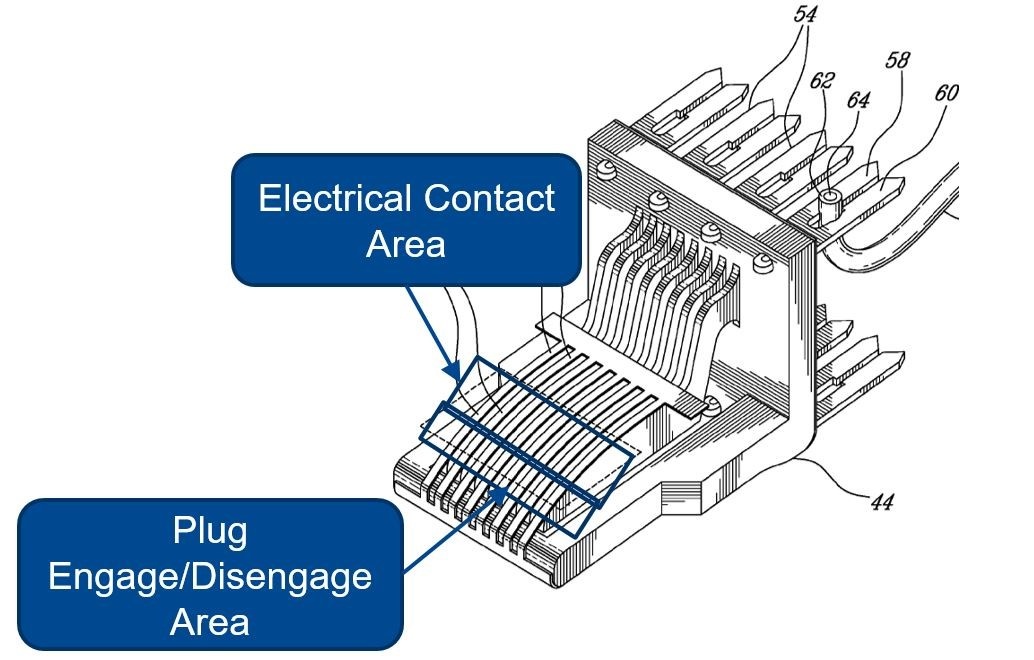
IEC 60603-7 also provides guidance on where contact should be made once a plug and jack are connected. According to the standard, the electrical contact should be made on the radius of the piercing insulation contact (PIC) – not on the top of the PIC. (See the image below.)

The electrical contact point on the radius of the PIC allows the plug to disengage outside the contact area, and ensures that plug removal won’t harm the data signal path in any way.
IEC PoE Reliability Testing
When it comes to plug removal under Power over Ethernet (PoE) load, there is currently no standard to meet. Instead, IEC 60512-99-001 offers a test method, or testing guidance. In a successful test, after 100 cycles at 600mA, the contact resistance change must be < 20 mΩ.
An updated version of this standard – IEC 60512-99-002 – is currently in draft form. Initially, it called for < 20 mΩ contact resistance change after 100 cycles at 1000mA. Now, it will call for < 20 mΩ contact resistance change after 100 cycles at 2000mA.
Belden’s connectivity solutions are always designed to meet all IEC electrical, mechanical and reliability requirements to ensure that plugs and jacks will successfully connect. Learn more about our newest connectivity system – REVConnect – here.
Über den Autor
Ron Tellas
Senior Solution Architect, Enterprise Solutions, Belden
Ron Tellas ist Fachexperte für HF-Design und elektromagnetische Ausbreitung. Er hat sich Belden im Jahr 2016 angeschlossen, um mitzuhelfen, den Zeitplan für Technologien und Anwendungen im Bereich intelligente Gebäude mitzugestalten. Dank dieser Erfahrungen kann er heute sehr effektiv Systeme, Geräte und Verbindungstechnik in Netzwerklösungen integrieren. Ron Tellas vertritt Belden in mehreren Standardisierungsorganisationen, Ausschüssen des National Electrical Code und als Vorstandsmitglied der FMP Alliance. Er hat einen Master- und Bachelor-Abschluss in Elektrotechnik und einen Master-Abschluss in Betriebswirtschaftslehre erworben und hat 17 US-Patente angemeldet. Er ist stolzer Empfänger des 2024 Harry J. Pfister Award, einer Auszeichnung, die er für seine herausragenden und eindrucksvollen Beiträge zur Telekommunikationsbranche erhalten hat.